Ceiling Leak Repair
Tea-brown rings, blistered paint and drooping board under a roof or pipe leak, replaced after the roofer or plumber has finished.
How leak-damaged ceilings are rebuiltColumbia County walls and ceilings
Storm-leak rings, settling cracks, AC overflow stains and knob punctures, trimmed back to firm gypsum, rebuilt level and given the same texture as the plane around them.
Describe the wall, and the Magnolia-area drywall finisher who would take it on rings to walk through it and price the fix.
Call 7 days, 7am–9pm
Before calling
Ten minutes spent here makes that opening conversation far more useful. Nothing below is required; each item just answers something the pro would otherwise ask.
Landlords and managers
Renters occupy 1,727 of Magnolia's 3,732 occupied homes, close to half, going by ACS five-year data for 2020–2024. Patching walls between leases goes with owning those units, and a bit of planning keeps it tidy.
Handling several doors across town? Say so early on, and we'll sort out how best to group them.
Services
Each card opens a page on why that damage happens, how a sound repair proceeds and what shifts its price.
Tea-brown rings, blistered paint and drooping board under a roof or pipe leak, replaced after the roofer or plumber has finished.
How leak-damaged ceilings are rebuiltHairlines climbing from door corners, split seams and the joint where wall turns into ceiling, opened and re-taped.
Reading and closing settling cracksRings and soft spots below an air handler whose condensate pan spilled or whose drain line choked.
Drywall damage from AC overflowKnob punctures, TV-mount anchor holes, plumbing access cuts and battered corners, brought flush and textured.
Patching holes and dented cornersMaterials
Any patch is judged by how well it copies its surroundings, and that copying starts below the paint.
Interior partitions mostly carry half-inch gypsum. Ceilings and garages often use five-eighths, and bathrooms sometimes have a moisture-resistant panel. Any insert must equal the thickness of its neighbors; otherwise it stands proud or sinks, and compound alone cannot level that.
Setting-type compound, nicknamed hot mud, sets by chemistry rather than by drying out. That suits deep fills and embedding tape over fresh cuts. Softer topping mud follows, since it sands easily and tapers to almost nothing at its margins.
Paper outperforms mesh in inside corners and across cracks with a history of moving. Fiberglass mesh suits flat patches, provided setting compound covers it; under lightweight mud the joint tends to reopen.
Knockdown, popcorn, smooth, orange peel and skip trowel: those five account for the surfaces most repairs blend into. Each calls for its own method, with gun pressure, mix consistency and knockdown timing rehearsed on offcuts before touching your wall.
Telling finishes apart, and copying each, gets fuller treatment in our guide to wall and ceiling textures.
Area
Magnolia serves as Columbia County's seat, and repairs reach out from it into these neighboring places.
Short descriptions sit among the notes on every town covered.
Process
Gypsum repair proceeds layer by layer, and every layer needs its own cure time. Below is the sequence, with each pause for curing marked.
Those pauses vary with the compound, how heavily it went on, and the air. Summer in Magnolia runs hot and muggy, and evaporating-type mud lingers wet in that dampness, which is partly why hot mud handles the deeper fills.
Who answers, who prices and how the work gets booked is set out on the about page.
Common cases
Houses of any vintage show these. Read them as general patterns, not accounts of particular homes.
A door flung open punches a fist-wide opening at handle height. Standard practice: square the opening, slip a wood cleat or two behind it, screw in an insert, tape, apply three coats, add texture. Fitting a baseboard or hinge-pin stop prevents a repeat.
A fine line angling upward off a doorway's top corner says the framing around that opening has moved slightly. Widened a touch, packed with hot mud, bridged with tape and tapered far out, it leaves no raised welt.
A tea-colored halo on a hallway ceiling, maybe spongy at its middle, frequently traces to an AC drain that clogged. With the HVAC fault cleared, the damp zone gets metered, removed if spongy, replaced, and coated in stain sealer ahead of texture.
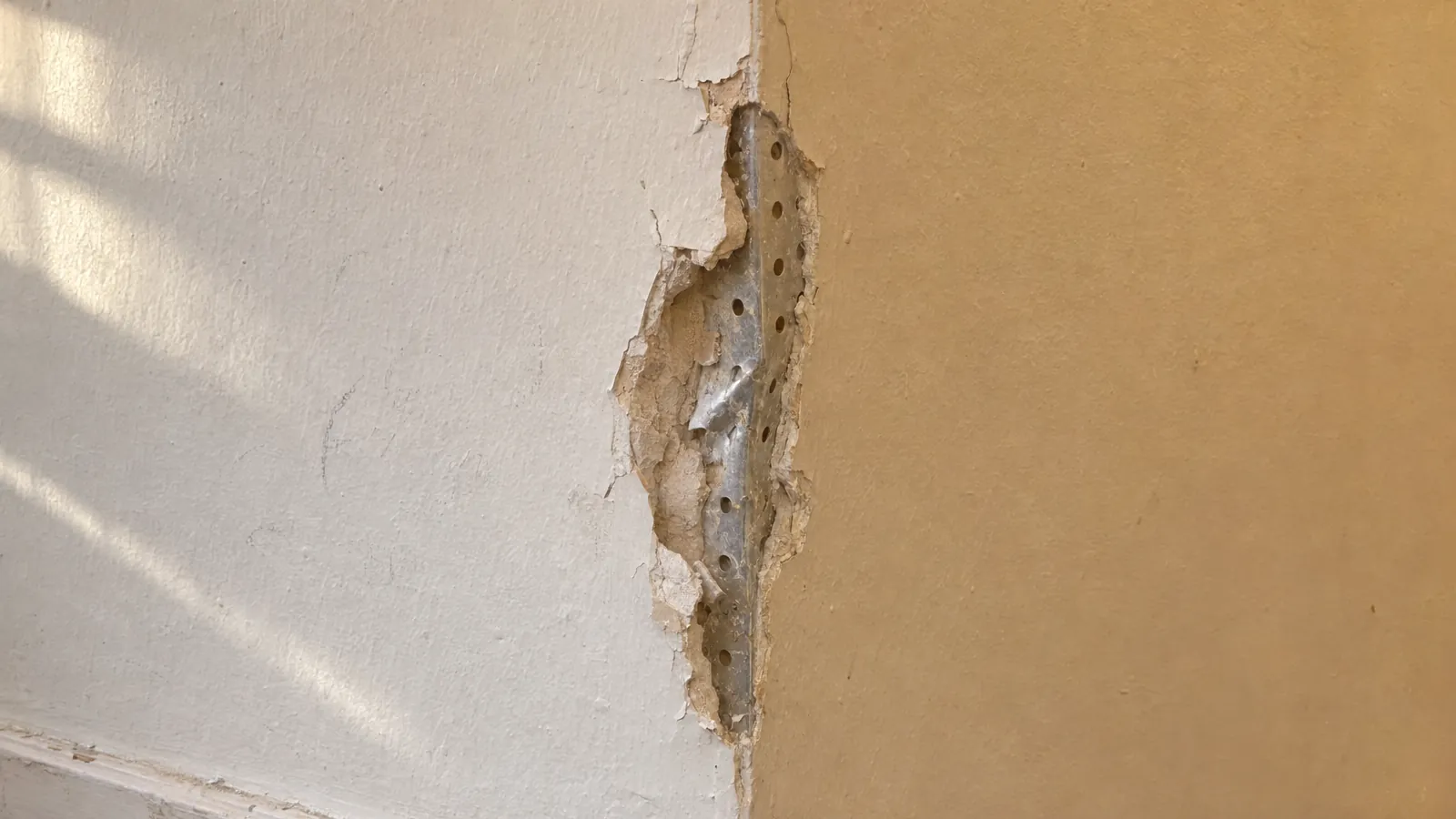
Dressers, vacuum cleaners and moving day all batter the metal bead on outside corners. Badly bent bead gets cut away and renewed; a shallow ding just gets filled. Either way a long blade trues the edge until it reads as one crisp line.
Local homes
Census takers in 2020 counted Magnolia's population at 11,162. ACS five-year data for 2020–2024 put the housing stock at 4,727, and 2,588 of them predate 1980, which is more than half. No single decade beats the 1980s, which supplied 1,073 of today's homes, while 514 surviving houses trace back to the 1940s.
Roughly two in three are detached houses. Duplexes and small multiplexes make up much of the rest, along with 747 homes inside buildings of five units or more and 292 mobile homes.
That range shapes repair work. Behind the paint of a 1940s or 1950s house there may be plaster or some early gypsum product, and any patch has to meet it at matching depth. Sprayed ceiling textures stayed popular for decades, so before anybody scrapes or cuts an aging popcorn ceiling, a sample belongs at an asbestos lab.
Climate adds wear too. Magnolia springs are warm and prone to strong or severe storms, the season when roof leaks tend to announce themselves overhead. Summers bring muggy heat, with highs in the mid to upper 90s, so air conditioners labor and their drain lines labor alongside. Winter can deliver snow and ice as well.
Separate pages go deeper on leak-stained ceilings, settling and seam cracks, AC drain overflow and holes and corner bead.
Get started
Call, send a picture as a text message, or use the form. Plain words about the damage are fine; questions on finish and cause can wait for the callback.
After that, a drywall finisher working around Magnolia calls you, ready to discuss the wall and what fixing it should cost.